Jacek
The PeasantsJacek is the squire’s brother and a former insurrectionist whose life connects the national cause to the unresolved conflict between the nobility and the peasants. He supports Rocho’s efforts to foster Polish consciousness in Lipce, but his return also unfolds as a search for Kuba, the former comrade he has been trying to find for years. His recognition of Boryna’s sacrifice and his vigil at Kuba’s grave make him a figure of political memory whose loyalties are tested against the human cost of the past.
Identity and Historical Position
Jacek belongs to the szlachta and is the brother of the squire at Wola. He is also a former participant in the uprising and a wartime comrade of Maciej Boryna. Those connections place him between two social worlds: the gentry whose political cause he once shared, and the peasant community whose experience of that cause is marked by punishment, loss, and distrust.
The novel identifies him as one of the people supporting Rocho, the principal advocate of Polishness among the peasants. Rocho’s work combines instruction, religious imagery, and the circulation of stories about Poland; Jacek’s support links that effort to the history of armed resistance. Yet the political meaning of the uprising is not shared uniformly in Lipce. The villagers remember the reprisals that followed, and participation in the insurrection does not automatically earn respect. Kuba, himself drawn into the struggle when others went, remains a disregarded farmhand. The anonymous graves of the fallen stand as a local record of loss rather than a public monument to national glory.
National Solidarity and Its Limits
Jacek’s ties to the squire do not erase the tensions that divide the gentry from the peasants. The novel presents land, security, and the injuries associated with the manor as more immediate concerns to Lipce’s inhabitants than Polish independence. Peasant suspicion of political appeals made in the name of Poland is therefore rooted in their own history: older villagers associate noble-led uprisings with renewed oppression and fear that peasants will again pay the price.
Jacek’s tribute to Boryna after his death makes that history personal. He recalls Boryna as a good man and a true Pole who joined the uprising freely and showed courage in action, then acknowledges that Boryna was ruined on account of the gentry. His words place responsibility on his own class rather than praising the insurrection as an uncomplicated act of national unity. The admission stands in sharp contrast to the squire’s response when Antek challenges the gentlemen’s historical conduct: the squire angrily tells the peasant to stay out of gentlemen’s affairs and return to his work. Jacek’s kinship with the squire thus makes his acknowledgment of noble responsibility especially consequential, without making him a substitute for the peasants’ grievances.
Return and Search for Kuba
Jacek’s later arrival in Lipce is driven by a search that has lasted for years. A stranger staying in the village asks whether Jakub Socha served with him; when the answer confirms that this is Kuba, Jacek learns that the man died in the autumn. He says he has searched for Kuba in villages throughout the surrounding area and has found him only after his death. The news makes clear that the connection between the two men has endured across distance and time, even though Kuba’s village life had passed largely without recognition.
The villagers already know that the squire’s brother has returned from distant lands and is looking for a man called Kuba, though no one knows which Kuba he seeks. When Jacek recognizes Witek as someone who knew the dead man, the boy offers to lead him to the grave. Witek knows its location because Ambrozy erected a cross and Rocho wrote a small board; even beneath the snowdrifts, he says, he can find the place. Jacek agrees to go before night falls. The practical care with which the grave has been marked allows the search, at last, to reach its destination.
The Grave and the Living Memory of War
The cemetery visit joins Kuba’s death to the wider memory of the uprising. The boy finds the cross beside the fence, alongside the tombstones of those who fell in the war. That location recalls the earlier account of the anonymous row of graves near the cemetery boundary, where Kuba had told Witek that his own kin, including his mother, lay among the dead. For Jacek, the site is not an abstraction about Poland: it is the resting place of the man he sought and part of a landscape shared by the families who remember the conflict through their dead.
As Witek explains what he knows of Kuba’s last illness and death, Jacek interrupts with questions, reacts with emotion, and spreads his hands in distress. The boy does not understand why the account affects him so strongly and is preoccupied with the darkening cemetery. He runs ahead until he finds the cross and spells out Kuba’s name, which Rocho wrote, while noting that Ambrozy fixed the cross in place. This small inscription gives Kuba the named grave he had lacked in the earlier account of the uprising’s forgotten dead.
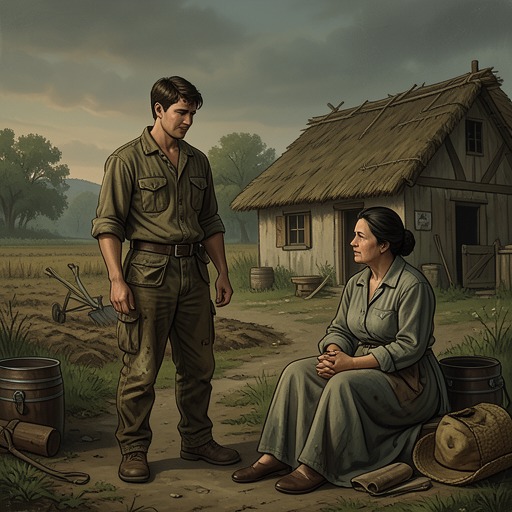
Jacek gives Witek a couple of zlotys and tells him to hurry home. The boy runs off, then looks back and sees Jacek kneeling at Kuba’s grave. His astonishment underscores the social distance between the squire’s brother and the village boy, but the gesture makes Jacek’s private allegiance unmistakable: at this moment he is not standing as a nobleman addressing a community, but kneeling beside a former comrade whose life the community had scarcely noticed.
Character and Narrative Significance
Jacek’s brief but weighty appearances connect political history to acts of recognition. His support for Rocho places him within an attempt to awaken national consciousness, while his words after Boryna’s death acknowledge that noble-led patriotism cannot be separated from the damage nobles inflicted on peasants. His search for Kuba extends that reckoning beyond public speeches: years of looking lead not to reunion but to a marked grave and a final act of respect.
The contrast between Jacek’s political identity and the villagers’ memory of the uprising remains unresolved. The novel does not suggest that his sympathy cancels the land conflict, the reprisals, or the mistrust of noble leadership. Instead, his mourning and his admission about Boryna reveal what a more honest remembrance requires: attention both to the cause invoked by the gentry and to the people who bore its consequences. At Kuba’s grave, that history narrows to a name on a cross and a man kneeling in the snow-darkening cemetery.